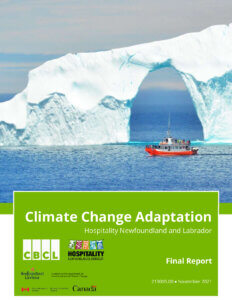
1. What is “Tourism Beyond Covid-19 – Climate Change Adaption” report?
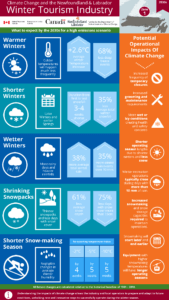
The Report provides a high-level summary of provincial climate projections and key impacts that the hospitality industry will face in the coming years as a result of climate change. The findings of the research were used to support the development of learning and knowledge tools to be used by operators to plan for climate change, including a climate projections summary document, sector-specific impact overviews, case studies to highlight examples of local adaptation measures, and a risk assessment tool for operators.
2. Why do businesses need to adapt to climate change?
Due to the impact of climate change on Newfoundland and Labrador’s land, ocean, and related ecosystems, businesses that heavily rely on these ecosystems won’t be able to operate in the same way over the coming years. Hence, businesses need to take
measures to adapt their operations to mitigate the impacts of climate change on their business to ensure long-term sustainability.
3. Is the climate changing in Newfoundland and Labrador?
Climate change and its impact on the land, ocean, and related ecosystems in Newfoundland and Labrador is real. Temperatures are increasing, sea levels are rising, and precipitation will increase. Seasonal snow and rain-on-snow patterns will fluctuate.
Coastal erosion may increase too. Less icebergs will be seen in select locations. The behaviour and quality of underwater and terrestrial species will change.
For more details, check Appendix A of Hospitality NL’s “Tourism beyond Covid-19 – Climate Change Adaptation” report (Link)
4. Is climate change already affecting local businesses?
Newfoundland and Labrador has been seeing more frequent unusual weather conditions/fluctuations such as extreme snow in 2020 followed by significantly low snow in 2021 and 2022, stormier weathers, high precipitation, warmer winters and more.
A CBC article in 2021 featured a local backcountry snowmobile guiding and rental company whose business was disrupted due to less snow (Full Story). That’s just one of the many examples. A severe rainstorm damaging roads and subsequently, cutting off
Channel-Port aux Basques from the rest of Newfoundland in 2021 is another example (Full Story).
5. Am I directly affected by climate change?
Climate change is impacting Newfoundland and Labrador’s land, ocean, and related ecosystems. Any business that heavily relies on these ecosystems is directly affected by climate change.
6. Do all sizes of businesses need a climate change risk assessment?
Yes. Whether large or small, climate change can disrupt any business.
7. My business is not directly affected by climate change. Do I need a climate change risk assessment?
While a business may not directly depend on Newfoundland and Labrador’s land, ocean, and related ecosystems, disruptions in these ecosystems can affect them indirectly. For e.g., a severe rainstorm damaged roads and subsequently cut off Channel-Port aux Basques from the rest of Newfoundland in 2021 (Full Story).
Hence, a business, e.g. a restaurant or retail, may not be directly affected by climate change but, an incident, such as a rainstorm damaging roads, has the potential to disrupt their supplies or lower sales due to a downturn in tourism.
8. What’s the next step if I want to prepare my business to adapt to climate change?
Stay in touch with Hospitality NL for upcoming webinars and workshops. You can follow us on Facebook, Instagram, and Twitter. And, sign up for our Newsletter (https://hnl.ca).
Lastly, you can get in touch with other organizations too in the province like DFO, ACOA, and others to understand how they can help businesses adapt to the impact of climate change.
9. How can I do a climate change risk assessment?
Contact Hospitality NL’s to discuss the process.
10. Where can I find more information?
Contact the Hospitality NL team at hnl@hnl.ca for more information.
Stay in touch with Hospitality NL for upcoming webinars and workshops. Follow us on Facebook, Instagram, and Twitter. And, sign up for our Newsletter (https://hnl.ca).
Get in touch with other organizations in the province like DFO, ACOA, and others to understand how they can help businesses adapt to the impact of climate change.
11. Where can I find Newfoundland and Labrador resources to adapt to climate change?
Hospitality NL (hnl.ca, hnl@hnl.ca)
Department of Environment and Climate Change Canada
Department of Environment and Climate Change Newfoundland and Labrador
Fisheries and Oceans Canada (DFO))
ACOA